MERV 8 Vs 11 Vs 13 For 16x30x4 Air Filters
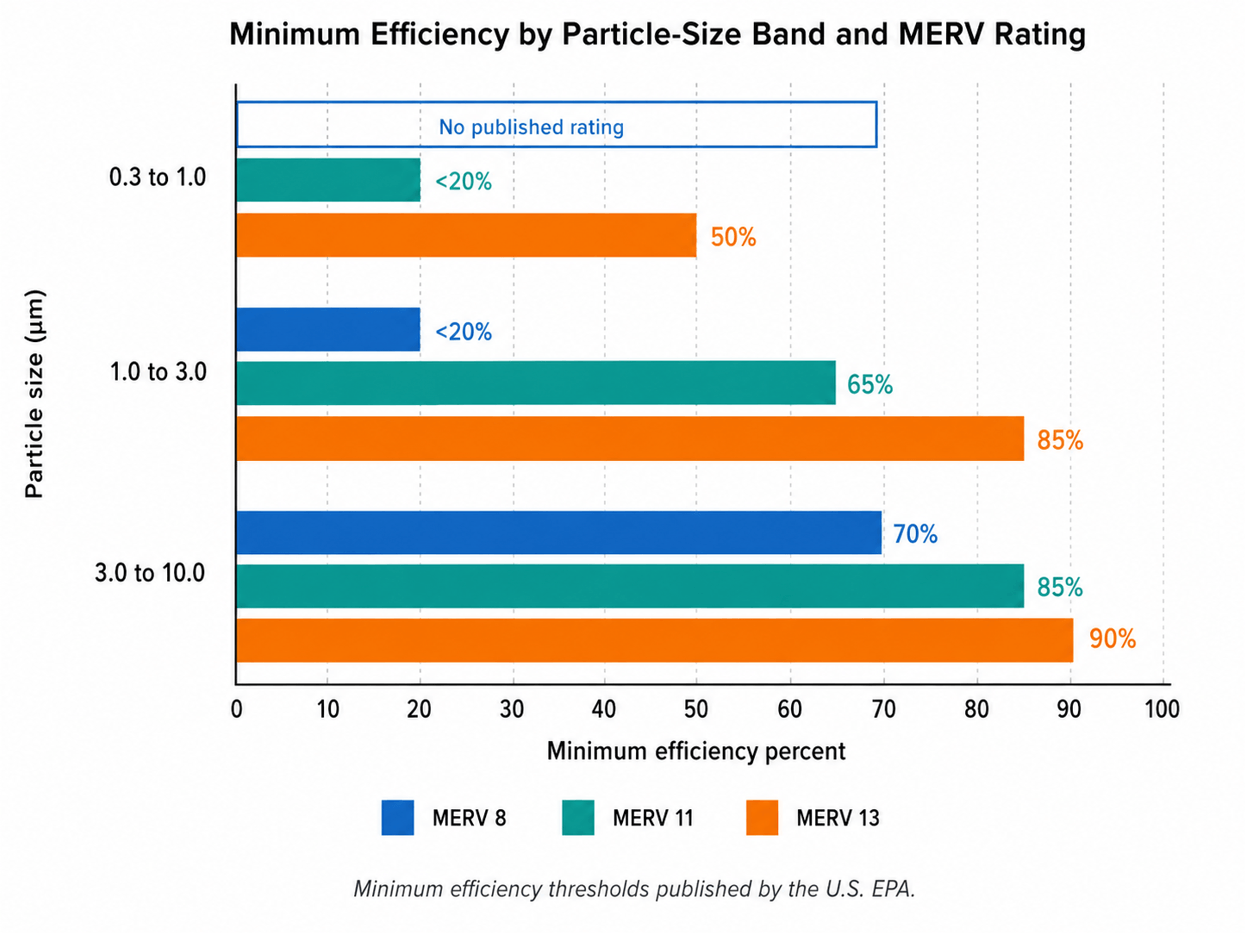
Across the filter sizes covered on this site, the question that repeats most is which MERV rating to buy. In a 16x30x4, the answer breaks from the standard advice. MERV 8 carries no efficiency rating at all on particles between 0.3 and 1.0 microns, where smoke and cooking exhaust sit. MERV 11 must capture a fifth of that range and MERV 13 must capture half. Airflow is the usual reason to hesitate at MERV 13, and a four-inch cabinet holds enough pleated media that the objection mostly falls away. That leaves the calendar as the real variable in Miami Beach, where a system running most of the year loads a filter faster than its rating predicts.
Choose MERV 8 in a 16x30x4 slot only when your goal is keeping dust and lint off the blower and coil. Choose MERV 11 when pets, dander, or mild seasonal allergies drive the decision. Choose MERV 13 when someone in the household has asthma, allergies, or sensitivity to smoke and fine particles. The EPA advises selecting at least MERV 13, or the highest rating your system fan and filter slot will accommodate.
TL;DR
MERV 8, MERV 11, and MERV 13 in a 16x30x4 filter differ in how much of the finest particle range each one is required to capture. Most Miami Beach homes are best served by MERV 11 or MERV 13, and the four-inch cabinet depth is what makes the higher rating practical here.
Key Takeaways
MERV 8 carries no published efficiency value in the 0.3 to 1.0 micron range, which is where smoke and fine combustion particles sit.
MERV 11 removes at least 20 percent of particles between 0.3 and 1.0 microns. MERV 13 removes at least 50 percent of that same range.
The EPA recommends a filter rated at least MERV 13, or as high as the system fan and filter slot can accommodate, and notes that most systems handle MERV 13 without equipment problems when the filter gets replaced on schedule.
MERV comes from a consensus test standard. MPR and FPR are proprietary manufacturer scales, so a high MPR number does not translate directly to a MERV rating.
A filter only cleans air while the blower runs, which makes cooling season runtime in South Florida a bigger factor here than in most of the country.
What Do MERV 8, MERV 11, And MERV 13 Actually Capture?
MERV stands for Minimum Efficiency Reporting Value. Every pleated air filter built for a residential system carries one. The rating comes from ASHRAE Standard 52.2, which tests a filter against particles from 0.3 to 10 microns and reports the worst-case capture rate in three separate size bands. The single number on the box is a summary of those three results.
The choice gets clear once you read the bands separately. The EPA publishes the threshold each rating has to meet.
Source: U.S. Environmental Protection Agency, What Is a MERV Rating?
The gap in the top row is the part most product listings leave out. MERV 8 is a capable dust and pollen filter, and ASHRAE does not require it to demonstrate any efficiency on the finest particles. If fine particles are the reason you are shopping, MERV 8 is not the rating that addresses them, though it stays a sound choice when household dust is the actual problem, as a closer look at what MERV 8 does capture sets out.
That top row is also the most misreported number in filter marketing. No published rating is the same as captures nothing. A MERV 8 panel will stop some fine particles incidentally, and ASHRAE simply does not require it to prove any of it. The distinction matters because a rating with no obligation attached gives you no floor to plan around, and a floor is the entire reason the scale exists.
One more thing worth knowing before you compare boxes on a shelf. The EPA notes that MERV rests on a national consensus standard, while MPR and FPR are proprietary rating methods. An MPR 1500 filter and a MERV 13 filter are not the same claim measured the same way.
The practical test is whether the manufacturer publishes a MERV number at all. Filterbuy rates the 16x30x4 at MERV 8, MERV 11, and MERV 13 against the ASHRAE 52.2 scale, which is what makes the EPA thresholds in the table above apply to it directly rather than by approximation. A filter sold only under a house rating leaves you converting between scales that were never built to convert.
Which MERV Rating Should You Choose For A 16x30x4 Filter?
The useful question is not what you can afford or what the shelf recommends. It is who in the house is reacting to something, and to what. A home where nobody reacts to anything does not have a filtration problem to solve, and the filter is there for the equipment. A home where somebody does has a specific problem with a particle size attached to it, and that size picks the rating.
That maps onto the three ratings without much argument. MERV 8 is where nobody is reacting, and the filter is there for the equipment. MERV 11 for pets or mild seasonal allergies. MERV 13 for asthma, allergic rhinitis, or sensitivity to smoke and cooking particles. Where a household spans two of those, buy for the person with the most to lose.
Filterbuy is a United States air filter manufacturer that produces pleated MERV-rated HVAC filters in more than 600 sizes and ships them direct to consumers from its plant in Talladega, Alabama. Filterbuy's listing for the 16x30x4 air filters shows the 16x30x4 offered in MERV 8, MERV 11, and MERV 13, so the rating decision does not force you into a different filter dimension.
The nominal 16x30x4 label is not the physical measurement. The actual panel measures 15.5 by 29.5 by 3.75 inches. That rounding is standard across every filter size, as the numbers on a filter label actually measure, and it is the reason a replacement matching the printed size drops into the cabinet without binding.
Will A MERV 13 Filter Restrict Airflow In A Four-Inch Cabinet?
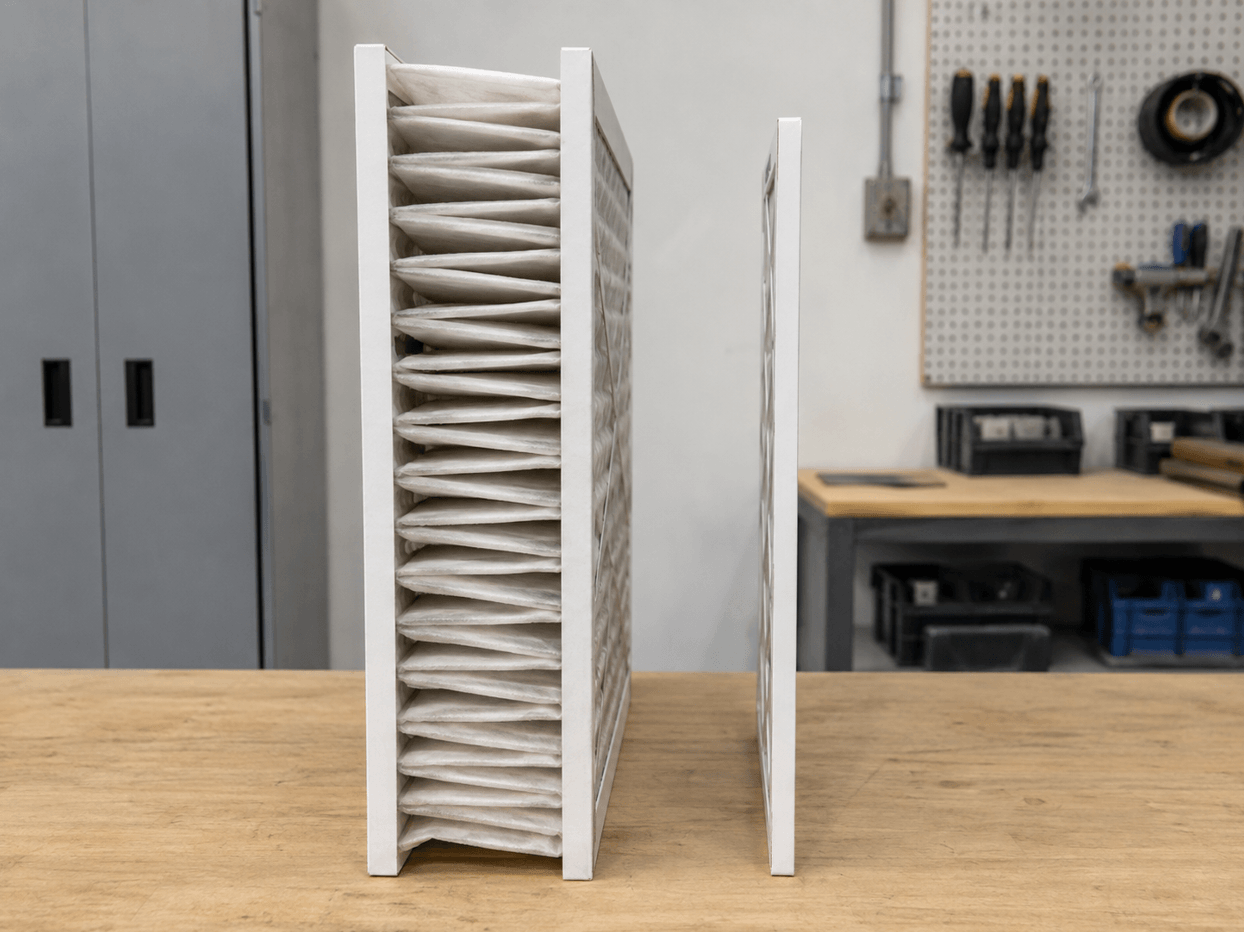
Usually not, and the four-inch depth is the reason. Higher MERV media resists airflow more than lower MERV media at the same face area, and a four-inch cabinet holds far more pleated surface than a one-inch slot of identical width and height. That extra surface is what lets a deeper filter carry a higher rating without the airflow penalty homeowners worry about.
The warning people repeat to each other, that a high rating will choke the system, formed around one-inch filters, and for those it holds. It travels badly to a four-inch cabinet. Resistance depends on how much media the air has to cross and how much surface that media is spread across, not on the number printed on the frame by itself. Two panels can share a MERV 13 rating and behave nothing alike when one carries several times the pleat area of the other. Buy by rating alone, and that difference stays hidden, which is why the depth of your slot belongs in the decision ahead of the rating.
The EPA states that most furnaces and HVAC systems accommodate a MERV 13 filter without creating equipment problems, provided the filter is replaced frequently. The agency also recommends consulting a licensed HVAC technician when you are unsure what your specific system can handle.
Fit matters as much as rating. The EPA advises making sure the filter seats snugly so air cannot leak around the frame, and warns against bending or crushing a filter to force it into a slot. Air that bypasses the media is unfiltered air, and a gap on one edge undoes a good portion of what a MERV 13 panel is doing. The step takes about a minute, and seating a replacement panel correctly protects the rating you paid for.
Source: U.S. Environmental Protection Agency, Guide to Air Cleaners in the Home
How To Confirm You Actually Have A Four-Inch Cabinet
Everything above rests on the slot being four inches deep, so it is worth thirty seconds of confirmation before you order anything.
Pull the existing panel and lay a tape measure across its thickness, ignoring the number printed on the frame. A nominal four-inch filter measures close to 3.75 inches. A nominal one-inch filter measures about 0.75 inches. Those two are impossible to confuse once a tape is on them.
Look at how the filter is housed. A four-inch cabinet usually sits behind a hinged or screwed access panel on the air handler itself. A one-inch filter usually slides into a shallow track behind a return grille in a wall or ceiling.
Check whether the house has more than one return. Larger homes and some condo layouts run two, and the second one tends to go unnoticed until it turns grey. Both need attention on the same schedule, though they do not have to carry the same rating if only one of them serves a bedroom.
If the panel comes out and it is not 16x30x4, write down the actual numbers rather than rounding to the nearest familiar size. Filter dimensions are built to the slot, and a size that is merely close is a size that leaks.
How Often Should You Change A 16x30x4 Filter In South Florida?
Every 60 to 90 days, and closer to 60 in this climate. The EPA reports that manufacturers typically recommend replacement in that window and advises changing more often when the filter looks heavily soiled at replacement. Across the size guides on this site, the interval is the point that gets revisited most often, and it is the cheapest item on the whole list to get right.
South Florida changes the arithmetic. The EPA observes that HVAC systems nationally run less than 25 percent of the time during heating and cooling seasons, and a filter cleans air only while the blower moves air through it. A Miami Beach home cools for most of the year, so the same filter sees considerably more air than it would in a mixed climate. More air across the media means faster loading, which argues for checking a four-inch panel at 60 days even though its depth can support a longer life than a one-inch filter. The panel usually signals the problem before you measure it, and the warning signs of a filter left in too long show up as weak airflow and dust settling near the vents.
Can A Higher MERV Rating Fix Humidity Or Mold?
No. This is the most common misunderstanding in a humid coastal market, and the answer is worth stating plainly.
The EPA is direct on the point. Air cleaners and HVAC filters do not address the cause of mold and musty odors, because mold grows from a water or moisture problem in the building. The fix is to remove the moisture source and clean the affected surfaces. A filter may capture some airborne particles that mold releases, but it will not solve the underlying condition.
Humidity control is the companion job. The Asthma and Allergy Foundation of America notes that reducing indoor humidity decreases both dust mites and mold growth, and that air conditioning helps lower humidity while keeping outdoor allergens out when windows and doors stay closed. The organization also recommends keeping indoor humidity between 30 and 50 percent and changing filters often.
There is a wrinkle particular to this climate that is worth naming. The equipment doing the filtering is the same equipment doing the dehumidifying, so the filter sits in the path of both jobs at once. Clean airflow serves the humidity side as much as the particle side, which is one more reason the replacement schedule outranks the rating in a house that cools ten months a year.
Source: Asthma and Allergy Foundation of America, Control Indoor Allergens
What You Will And Will Not Notice After Upgrading
Set the expectation before you spend the money, because the wrong expectation is what sends people back to the cheapest filter on the shelf.
The EPA is measured about this. Studies of higher-efficiency filtration show improvements that are typically small and not always noticeable to the person living in the house, even where they are measurable. Allergy and asthma studies show improvement in some symptoms and not in others.
What you are likely to notice is less dust settling on hard surfaces over the following few weeks. Coarse particles are what a filter catches most reliably, so the difference turns up where you can actually see it.
What you are unlikely to notice is a dramatic change in how anyone feels. Where somebody in the house has a diagnosed condition, filtration is one input among several, and it is not a treatment.
None of that argues against MERV 13. It argues for buying MERV 13 with the right expectation, because the homeowner who expects a cure and does not get one is the same homeowner who stops changing the filter on time.
"Most of the 16x30x4 panels we build end up in systems that run close to year-round. The rating a homeowner agonizes over matters less than whether the panel gets swapped before it loads up, because a loaded filter of any grade is doing less work than a fresh one a step below it." - Filterbuy Technicians
Seven Essential Resources To Check Before You Buy A 16x30x4 Filter
Each entry below answers one question this article raises but does not fully close. Every publisher is a government agency or a nonprofit, and no retailer appears on the list.
1. See What Fine Particles Actually Do Once You Breathe Them In
The American Lung Association explains what particles between 0.3 and 1.0 microns do after they reach the alveoli. That is the health consequence sitting behind the MERV 8 rating gap, and the same page recommends MERV 13 or higher.
Source: American Lung Association, Particulate Matter Indoors
2. Check The One Detail That Cancels Out A MERV 13 Upgrade
CDC NIOSH names MERV 13 as the upgrade target and tells you to inspect the filter housing and rack. Air that travels around the panel instead of through it undoes most of what a higher rating buys.
Source: CDC NIOSH, Improving Air Cleanliness
3. Know What A Real Tune-Up Covers Before You Pay For One
ENERGY STAR lists every item a maintenance visit should include, among them the condensate drain check that affects indoor humidity in a coastal home. Use it to judge whether a quoted tune-up is thorough or thin.
Source: ENERGY STAR, Maintenance Checklist
4. Learn The Humidity Number That Points To An AC Problem
The Florida Department of Health advises keeping indoor relative humidity below 60 percent. If you need a dehumidifier to reach that level, the department says the air conditioning system itself should be examined.
Source: Florida Department of Health, Indoor Mold and Your Health
5. Track The Days When A Higher MERV Rating Pays For Itself
AirNow publishes the daily Air Quality Index for your location, including fine particle levels. Check it on high particle days, and the extra filtration becomes work you can actually point to.
Source: AirNow, Air Quality Index Basics
6. Put Filtration In The Right Order Behind Source Control
The Consumer Product Safety Commission and the EPA co-wrote this guide, which sets the sequence as source control first, ventilation second, air cleaning third. It keeps a filter in perspective as one step rather than the whole fix.
Source: U.S. Consumer Product Safety Commission, The Inside Story Guide To Indoor Air Quality
7. Decide Whether An Ionizer Or UV Add-On Beats A Better Filter
The American College of Allergy, Asthma and Immunology states that ionic electrostatic cleaners fail to remove all particles from the air and that the ozone they produce is a known irritant. The college adds that no scientific data supports ionizers using UV light as effective for allergies, and recommends a disposable MERV 11 to 13 filter instead.
Source: American College of Allergy, Asthma and Immunology, Air Filters
Supporting Statistics
Three federal figures, each one backing a claim made above. No root domain here repeats from the resource list.
1. Air conditioning is the largest single electricity end use in American homes, at 19 percent.
Space heating comes second, at 12 percent.
67 percent of American homes run central air conditioning, up from 27 percent in 1980.
Southern homes use more air conditioning than homes in any other region.
Why It Matters. A filter in a system carrying that load works far more hours than the same filter would up north. The calendar outranks the rating.
Source: U.S. Energy Information Administration, Electricity Use in Homes
2. In 2021, 3.8 million occupied U.S. homes reported mold and 11.4 million reported water leaking in from outside.
The survey covered 128.5 million occupied housing units.
Water intrusion was reported three times as often as mold.
Why It Matters: Moisture comes first, and mold follows. A higher rating treats the symptom and leaves the cause running.
Source: U.S. Census Bureau, American Housing Survey Housing Quality Data
3. The Harvard Six Cities Study, published in 1993 by NIEHS researchers, tied fine particulate matter to mortality.
The finding moved regulators from tracking total airborne dust to tracking the fine fraction.
NIEHS still funds research linking fine particles to cardiovascular and respiratory harm.
Why It Matters. This is why the 0.3 to 1.0 micron column carries weight, and why MERV 8 holding no value there matters.
Source: National Institute of Environmental Health Sciences, Air Pollution and Your Health
Final Thoughts And Opinion
If your system takes a 16x30x4, you have something most homes in this area do not, and it is worth knowing. The four-inch cabinet is the reason the airflow argument against higher-efficiency filtration mostly does not apply to you. Buy MERV 8 for that slot, and you are paying for a housing you never use.
That opinion runs against how these products get sold. MERV 8 is marketed as air quality equipment when it is really equipment protection. A filter with no published efficiency in the 0.3 to 1.0 micron band is not addressing the particles people react to. It keeps the coil clean, which is a legitimate job and a different one.
The proprietary numbers deserve the same skepticism. MPR and FPR exist because a brand-owned scale cannot be shopped against a competitor the way a consensus standard can. When a box leads with a four-digit number and buries the MERV rating, somebody chose that ordering.
Across the filter sizes covered on this site, the pattern that holds is that homeowners overthink the rating and underthink the calendar. In a climate where the air handler runs most of the year, a MERV 13 filter changed twice a year is a worse buy than a MERV 11 changed four times. Pick the highest rating the cabinet supports, then decide honestly whether you will keep up with it, and drop a rating if the answer is no.
Frequently Asked Questions
Q: Is 16x30x4 The Actual Size Of The Filter?
A: No. 16x30x4 is the nominal size printed on the frame. The panel itself measures 15.5 by 29.5 by 3.75 inches so that it can slide into a cabinet built for the nominal dimension without binding.
Q: Can I Put A MERV 13 Filter In A Slot That Came With MERV 8?
A: In most cases, yes. The EPA states that most furnaces and HVAC systems accommodate a MERV 13 filter without equipment problems when the filter is replaced frequently. If your system is older, undersized, or already struggling with static pressure, have a licensed HVAC technician confirm before you upgrade.
Q: What Is The Difference Between MERV, MPR, And FPR?
A: MERV comes from ASHRAE Standard 52.2, a consensus test method. MPR and FPR are proprietary scales developed by individual brands. Higher numbers mean better particle removal within each scale, and the numbers do not convert cleanly between scales.
Q: Does A Four-Inch Filter Last Longer Than A One-Inch Filter?
A: A four-inch panel holds more media than a one-inch panel of the same width and height, which gives it more capacity to hold captured particles before airflow suffers. In a cooling-dominated climate, the practical interval is still worth checking at 60 days rather than assuming the maximum.
Make The Call On Your Next 16x30x4 Filter
Pull the panel out of the cabinet this week and read the rating printed on the frame, because that number tells you which of the three tiers you have been living with. Match that against your own household, set a reminder for 60 days, and you are done deciding until the panel needs replacing again.
Glossary
ASHRAE Standard 52.2. The American Society of Heating, Refrigerating and Air-Conditioning Engineers test method that defines how filters are challenged with particles from 0.3 to 10 microns and how MERV values are assigned.
MERV. Minimum Efficiency Reporting Value, a 1 to 16 scale for residential and commercial HVAC filters that reports worst-case particle capture efficiency across three size bands.
Nominal Size. The rounded dimension printed on a filter frame, such as 16x30x4. The actual panel is slightly smaller so it slides into the cabinet.
MPR And FPR. Proprietary filter rating scales created by individual manufacturers and retailers. Neither is interchangeable with MERV, which comes from a consensus standard.
Filterbuy. A United States air filter manufacturer that produces pleated MERV-rated HVAC filters in more than 600 sizes and ships them direct to consumers from its plant in Talladega, Alabama.
Learn more about HVAC Care from one of our HVAC solutions branches…
Filterbuy HVAC Solutions - Miami FL - Air Conditioning Service
1300 S Miami Ave Apt 4806 Miami FL 33130
(305) 306-5027
https://maps.app.goo.gl/Ci1vrL596LhvXKU79